
2026 Fulton Senior Tax Breaks: Save $1,000+
(Are You Eligible)



Thousands of Fulton County seniors are leaving more than $1,000 on the table every single year. Not because the money isn’t available — but simply because they don’t know they qualify, miss the deadline, or claim only one exemption when they’re actually eligible for three.
If you’re 62 or older, own your home in Fulton County, and use it as your primary residence, there’s a strong chance the 2026 Fulton senior tax breaks could significantly cut your annual property tax bill. Some homeowners save as little as a few hundred dollars. Others — especially those on fixed incomes who qualify for the school tax exemption — save well over $1,500 per year.
In this guide, we’ll break down every available Fulton County senior tax exemption for 2026, walk you through a quick eligibility quiz so you know exactly what you qualify for, and give you a step-by-step roadmap to apply before the April 1 deadline.
What Are Fulton Senior Tax Breaks? (A 2026 Overview)
Fulton senior tax breaks are property tax exemptions, freezes, and relief programs designed to reduce the annual tax burden for older homeowners in Fulton County, Georgia. They come in two layers: programs offered at the state level through the Georgia Department of Revenue, and additional programs offered directly by Fulton County.
Many seniors are surprised to learn that both layers exist — and that they can be stacked on top of each other for maximum savings. Understanding the difference is the first step toward claiming everything you’re owed.
There are three main types of senior tax relief programs in Fulton County:
• Homestead Exemptions — reduce the taxable value of your home
• School Tax Exemptions — remove or reduce the school portion of your tax bill, which is typically the largest component
• Value Freeze / Floating Homestead — freeze your home’s assessed value so rising property prices don’t increase your taxes
For 2026, income thresholds on several programs have been adjusted. Seniors who previously checked their eligibility and found they were just over the limit may now qualify. It’s worth reviewing your status every year. You can verify current program details directly on the Fulton County Board of Assessors website.
5 Fulton County Senior Tax Exemptions You Can Claim in 2026
Most seniors in Fulton County are eligible for more than one exemption — but far too many claim only the basic homestead exemption and stop there. Here are five programs you should know about, what they cover, and how much you can save.
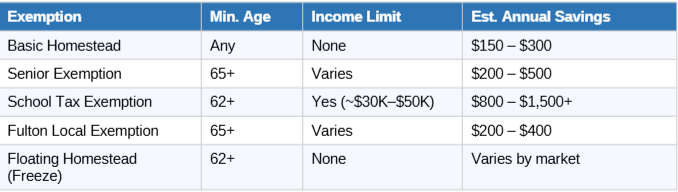
1. Basic Homestead Exemption — Available to any Fulton County homeowner who occupies the property as their primary residence. This is the foundation for all other exemptions and is required before you can stack additional programs. Estimated savings: $150 to $300 per year.
2. Senior Exemption (Age 65+) — Once you turn 65, you become eligible for an additional exemption on top of the basic homestead. This reduces the assessed value of your home further, lowering the amount on which your property taxes are calculated. Estimated savings: $200 to $500 per year depending on your home’s value.
3. School Tax Exemption (Age 62+ or 65+) — This is the most valuable exemption available to Fulton County seniors. Because school taxes typically represent 60 to 70 percent of your total property tax bill, removing or significantly reducing them can save eligible seniors $800 to $1,500 or more annually. Income limits apply, so check the current thresholds.
4. Fulton County Local Exemption — This is a county-specific add-on that goes beyond what the state of Georgia offers. Not all Georgia counties have this — Fulton County’s version provides additional relief for qualifying seniors and can be stacked with state exemptions for compounding savings.
5. Floating Homestead (Value Freeze) Exemption — This program freezes the assessed value of your home at the time you first apply. Even if Fulton County’s property values rise sharply — as they have in recent years — your tax assessment stays locked. This is especially powerful for seniors in rapidly appreciating neighborhoods like those in Buckhead, East Point, and Sandy Springs.
Here’s a quick summary comparison of each exemption:
Do You Qualify? 2026 Fulton Senior Tax Break Eligibility Quiz
Not sure whether you qualify? Answer these five questions to find out which Fulton senior tax breaks you may be eligible for in 2026. This quick quiz takes under 60 seconds.
Question 1: Are you 62 years of age or older?
• Yes — You may qualify for the School Tax Exemption and the Floating Homestead. Keep going.
• No — You may still qualify for the Basic Homestead Exemption. Contact the Tax Commissioner’s office for other relief options.
Question 2: Is this property your primary residence in Fulton County?
• Yes — You meet the residency requirement for all Fulton senior tax breaks. Continue.
• No — Tax exemptions are tied to your primary domicile. You will not qualify for property tax breaks on secondary or investment properties.
Question 3: What is your annual household income?
• Under $30,000 — You likely qualify for the full School Tax Exemption and all available senior programs.
• $30,000 to $50,000 — You may qualify for partial school tax relief and most senior exemptions. Verify against current income thresholds.
• Over $50,000 — You may qualify for the Basic Homestead, Senior Exemption, and Floating Homestead, but some income-restricted programs may not apply.
Question 4: Have you already filed a Homestead Exemption on this property?
• Yes — Great. You’re already in the system. Now check whether you’ve applied for additional senior-specific exemptions.
• No — You need to file this first. All senior exemptions are layered on top of the basic homestead filing.
• Not Sure — Call the Fulton County Tax Commissioner at (404) 612-6440 to verify your current exemption status.
Question 5: Are you a surviving spouse of a senior who previously held an exemption?
• Yes — You may be entitled to continue the exemption under Georgia’s surviving spouse provisions, provided you meet age and residency requirements.
• No — Proceed with your individual eligibility based on the answers above.
Quiz Disclaimer: These results are estimates intended to guide your research. Actual eligibility is determined by the Fulton County Tax Commissioner. Always confirm your specific situation with an official before filing.
2026 Income & Age Requirements: What You Need to Know
Eligibility for Fulton senior tax breaks depends on three primary factors: your age, your household income, and your residency status as of January 1 of the tax year. Here’s what each requirement actually means in plain language.
Age Requirements
The two key age thresholds in Fulton County’s programs are 62 and 65. At age 62, you become eligible for the School Tax Exemption and the Floating Homestead. At age 65, you gain access to additional senior exemptions, including Fulton’s local add-on programs. Your age is evaluated as of January 1, 2026.
Income Limits
Income limits are program-specific and based on your combined household income. Importantly, Georgia excludes the first $40,000 of retirement income (including Social Security, pension income, and IRA distributions) from the income calculation for several senior exemption programs. This means many seniors who think they earn too much actually fall well under the threshold once eligible exclusions are applied.
For most school tax relief programs, the qualifying income ceiling is in the range of $30,000 to $50,000 in net countable income — but this can vary. Always verify the current figure with the Tax Commissioner, as thresholds are subject to legislative update. The Georgia Department of Revenue’s Fulton County property tax facts page provides the most current state-level income guidelines.
Residency Requirements
The property must be your legal primary domicile as of January 1, 2026. If you own multiple properties, only your primary residence qualifies. Snowbirds and seasonal residents should take note: if your legal domicile is in another state or county, you will not qualify.
Surviving Spouse Provisions
If your spouse previously held a senior exemption on your shared home and has since passed away, you may be eligible to continue receiving the exemption — even if you yourself are under 62. Georgia law includes specific surviving spouse provisions, but they require a new application. Many widows and widowers unknowingly lose these exemptions simply because they don’t re-file.
Disability-Based Exemptions
Seniors who also qualify under disability provisions may access additional relief programs. If you receive disability income or Social Security Disability Insurance (SSDI), ask the Tax Commissioner’s office about layering disability exemptions with your senior exemptions.
How to Apply for Fulton Senior Tax Breaks (Step-by-Step)
Applying for Fulton County senior tax exemptions is straightforward — but the April 1, 2026 deadline is firm. Miss it, and you’ll wait another full year. Here’s exactly how to apply.
1. Gather Your Documents — Before you visit an office or fill out an online form, collect the following: a valid government-issued photo ID (driver’s license or passport), proof of age (birth certificate or ID), proof of income for the previous tax year (tax return, Social Security award letter, or pension statement), and your property deed or mortgage statement confirming ownership.
2. Choose Your Application Method — You can apply in three ways:
• Online: Visit the Fulton County Tax Commissioner’s exemptions portal at fultoncountytaxes.org (fastest option)
• In-Person (North Fulton): Alpharetta Service Center, 11575 Maxwell Road, Alpharetta, GA 30009
• In-Person (South Fulton): 5600 Stonewall Tell Road, College Park, GA 30349
• By Mail: Fulton County Tax Commissioner, 141 Pryor Street SW, Suite 1085, Atlanta, GA 30303
3. Submit Your Application Before April 1, 2026 — This is the hard deadline for exemptions to apply to your 2026 tax bill. If mailing, allow extra time for delivery.
4. Confirm Receipt — If applying online, you’ll receive a confirmation email. If applying by mail or in person, ask for a stamped receipt. Follow up within two weeks if you haven’t received confirmation.
5. Review Your Updated Tax Bill — Exemptions approved before April 1 will be reflected in your annual tax bill, typically mailed in the fall. Verify the exemptions are properly applied.
Good news: Once approved, your exemptions renew automatically each year as long as your eligibility doesn’t change. You don’t need to re-apply annually — but you do need to notify the Tax Commissioner if you move, sell your home, or experience a significant income change.
Common Mistakes That Cost Fulton Seniors Their Tax Breaks
Even well-informed homeowners make errors that result in thousands of dollars in preventable tax payments. Here are the six most common mistakes — and how to avoid them.
Mistake #1: Assuming You Don’t Qualify — Many seniors rule themselves out before they even look into it, often because they assume their income is too high. But Georgia’s income calculation excludes significant portions of retirement income, meaning your countable income is often far lower than your gross income. When in doubt, apply anyway and let the Tax Commissioner’s office make the determination.
Mistake #2: Missing the April 1 Deadline — There is no grace period and no retroactive credit for late applications. If you miss April 1, 2026, you’re paying full taxes for the entire year. Mark it in your calendar today.
Mistake #3: Claiming Only One Exemption — The most common and most costly mistake. Seniors who qualify for the school tax exemption also typically qualify for the basic homestead, the senior exemption, and potentially the floating homestead. All four together can save $1,500 or more annually. Always apply for everything you’re eligible for.
Mistake #4: Not Updating After a Spouse’s Death — When a qualifying senior passes away, their surviving spouse must file a new application to continue the exemption. This does not happen automatically, and many surviving spouses unknowingly pay full taxes for years as a result.
Mistake #5: Confusing City and County Taxes — Residents who live within the City of Atlanta pay both Atlanta city taxes and Fulton County taxes. The exemptions discussed in this article apply to the county portion of your bill. You may also be eligible for separate exemptions on the city portion — contact the Atlanta city tax office for details.
Mistake #6: Forgetting to Re-Apply After Moving — Your exemption is tied to your specific property, not your identity. If you sell your home and buy a new one, even within Fulton County, you must file a new application for the new property. Exemptions do not transfer.
Additional Resources & Programs for Fulton County Seniors
Beyond property tax exemptions, Fulton County seniors have access to a range of programs and resources that can provide additional financial relief.
Georgia Department of Revenue — Senior Exemption Codes — The state offers several additional exemption codes (including L5A and L6) that stack on top of local programs. The Georgia DOR Fulton County property tax facts page has the most current list of state-level senior programs and income thresholds.
Fulton County Tax Commissioner — The Fulton County Tax Commissioner’s official website is your single most important resource. Staff can confirm your current exemption status, help you identify programs you may have missed, and walk you through the application process. Reach them at (404) 612-6440.
Fulton County Board of Assessors — For questions about your home’s assessed value or to start a property tax appeal, the Fulton County Board of Assessors handles assessments and exemption applications. If you believe your home is over-assessed, a lower assessed value means lower taxes regardless of which exemptions you hold. Appeals must be filed within 45 days of receiving your assessment notice.
AARP Foundation Tax-Aide Program — AARP’s free Tax-Aide program offers in-person and virtual help for seniors filing taxes and navigating property tax exemptions. It’s the nation’s largest free volunteer-run tax preparation service and is open to anyone — you don’t need to be an AARP member. Find a location near you at the AARP Foundation Tax-Aide locator.
Georgia Legal Aid — Property Tax Exemption Guide — For seniors who need help understanding or disputing exemption decisions, GeorgiaLegalAid.org’s property tax exemptions guide provides plain-language explanations of every statewide exemption program. For Fulton County residents needing direct legal assistance, Atlanta Legal Aid Society can be reached at 404-524-5811, and Georgia Senior Legal Aid is available at 404-389-9992 for adults over 60.
Final Thoughts: Don’t Leave Your Savings on the Table
The 2026 Fulton senior tax breaks are real, significant, and accessible — but they are not automatic. You have to know they exist, confirm you qualify, and apply before the April 1 deadline. The good news is that once you’re in the system, the savings repeat every year without additional effort.
Whether you’re newly eligible at 62 or have owned your home in Fulton County for decades, this is the year to take five minutes and verify that you’re claiming everything you’re entitled to. Scroll back up to take the eligibility quiz, then contact the Fulton County Tax Commissioner to confirm your results and start your application.
Share this guide with a neighbor, parent, or friend who owns a home in Fulton County. The savings are too good to miss — and too easy to apply for not to try.
Apply by April 1, 2026. Call the Fulton County Tax Commissioner at (404) 612-6440 or visit fultoncountytaxes.org to get started today.
If you have questions about your property situation in Fulton County, Atlanta Housing 411 is here to help. Reach out anytime — call or text 404-913-7086, or email atlanta285.com@gmail.com. No pressure — just local guidance you can trust.