
Fulton County Delinquent Tax List: How to Check It Free
(And What to Do If You’re On It)


The Fulton County delinquent tax list is public record — which means real estate investors, cash buyers, and wholesalers are looking at it right now. If you own property in Fulton County and have fallen behind on taxes, there’s a real chance your address is already on that list. And if it is, the clock is moving whether you know it or not.
This guide is written for two different readers. If you’re a homeowner who wants to check your own tax status, we’ll walk you through exactly how to do that for free. If you already know you’re behind, we’ll explain what stage you’re in, what your balance actually includes, and what your realistic options are before a tax sale changes everything.
Being on the Fulton County delinquent tax list is not the end. For thousands of Fulton County homeowners every year, it is a temporary situation that gets resolved — either through payment, through an exemption program, or through a voluntary sale that puts money in the homeowner’s pocket rather than letting it vanish at a public auction. What matters most is understanding where you stand and acting before your options narrow.
What Is the Fulton County Delinquent Tax List?
The Fulton County delinquent tax list is a public record maintained by the Fulton County Tax Commissioner that identifies properties with unpaid property taxes from prior tax years. It is not a secret database or a private collection tool — it is a public record, accessible to anyone, and regularly used by investors, attorneys, title companies, and housing advocates.
In Georgia, property taxes become delinquent after December 20 of the tax year — the day after the standard payment deadline. From that point forward, interest begins accruing at 1% per month, and the path toward a tax sale begins. The delinquent tax list is essentially the master record of every Fulton County property that has not resolved its tax obligation from a prior year.
What the List Contains
• Property owner name as it appears in the public record
• Property address and parcel identification number (PIN)
• The amount of unpaid taxes owed, including accrued interest and penalties
• Whether a Fi. Fa. (tax execution or lien) has been recorded against the property
• Whether the property has been scheduled or advertised for tax sale
The Different Stages of Delinquency
Not every property on the Fulton County delinquent tax list is in the same situation. There is an important difference between a property that is 60 days past due and one that is actively advertised for auction. The list captures all of them, but what it means for the homeowner depends on which stage the property has reached.
Who Uses the Delinquent Tax List and Why
Homeowners check the list to verify their own status or confirm a payment was received. Real estate investors use it to identify potential acquisition targets. Title companies run lien searches to ensure clean title before closing. Attorneys and housing counselors use it to assess client situations. Journalists and researchers use it to track housing instability trends across the county. Understanding that investors are actively monitoring this list — and will contact homeowners directly — is important context for every property owner in Fulton County.
How to Search the Fulton County Delinquent Tax List for Free
The search is completely free, requires no account or registration, and takes less than five minutes. Here’s exactly how to do it.
1. Go to the official website: Open a browser and navigate to fultoncountytaxes.org — the official website of the Fulton County Tax Commissioner property tax search tool. Do not use third-party sites that charge fees for this information; the official source is free.
2. Select the property tax search: From the main menu, navigate to the “Property Taxes” section. Look for the property search or tax lookup tool.
3. Enter your property information: You can search by property address (street number and street name) or by parcel ID number. Your parcel ID appears on your annual tax bill, your property deed, and on the Fulton County Board of Assessors website.
4. Review your property record: Your search result will display your property’s tax history, current balance, any outstanding delinquency, Fi. Fa. status, and whether the property is flagged for tax sale proceedings.
5. Understand what you’re seeing: The balance shown is your full payoff amount — it includes the original unpaid taxes, accumulated monthly interest, the 5% penalty, any Fi. Fa. recording fees, and attorney or collection fees if applicable.
Alternative: Search the Superior Court Fi. Fa. Records
If you want to confirm whether a tax execution lien has been formally recorded against a property, the Fulton County Superior Court Clerk’s website allows you to search recorded Fi. Fa. documents by owner name or property address. This is particularly useful if you’re a buyer or investor conducting due diligence on a property, or if you want to verify that a Fi. Fa. has been officially released after payment.
Finding the Tax Sale Advertisement List
Once a property is scheduled for tax sale, Fulton County is required to publish a legal notice in a designated local newspaper for four consecutive weeks before the auction date. These advertisements are also available through the Tax Commissioner’s office. If you want to know whether your property has been advertised — or you’re an investor tracking upcoming sales — this is the source to check.
Important: If you made a payment recently and it still shows as delinquent, allow 5–10 business days for the record to update. If it persists, call the Tax Commissioner’s office at (404) 612-6440 to confirm receipt and request a balance update.
What Does It Mean If You’re on the Fulton County Delinquent Tax List?
Finding your property on the Fulton County delinquent tax list is alarming — but what it means in practical terms depends entirely on which stage of the delinquency process you’re in. There is a significant difference between owing taxes from last December and having your home advertised in a newspaper for auction next month. Understanding your stage is the first step.
Stage 1: Unpaid Balance, No Fi. Fa. Yet — You have unpaid taxes but the county has not yet issued a formal tax execution. This is the least costly stage to resolve. Your balance is the original tax amount plus interest at 1% per month. Call the Tax Commissioner, get your payoff figure, and resolve it before a Fi. Fa. is recorded.
Stage 2: Fi. Fa. Recorded — A tax execution has been formally recorded in Fulton County Superior Court. This is a lien on your property title — it prevents any sale or refinance and adds recording fees and potentially attorney fees to your balance. The situation is more serious but still very resolvable. Get your updated payoff figure immediately.
Stage 3: Tax Sale Advertised — Your property has been scheduled for public auction and is being advertised in a local newspaper. You have weeks, not months. A voluntary sale, full payment, or emergency intervention is needed now. Every day of inaction narrows your options further.
Stage 4: Post-Tax Sale — A third party has purchased your property at the Fulton County tax auction. You have not yet lost all rights — under Georgia law (O.C.G.A. § 48-4-40), you retain a 12-month right of redemption. But the redemption amount is now the winning bid plus a 20% premium, which is typically far higher than the original delinquency. Get legal help immediately.
Many homeowners only discover they’re on the Fulton County delinquent tax list when they receive a letter from an investor, hear about it from a neighbor, or stumble across it online. That discovery moment is disorienting. The goal of this section is to replace that panic with clarity: you know which stage you’re in, you know what it costs, and you know what your options are.
Being on the Fulton County delinquent tax list is not the end. It is a signal to act — and the sooner you act, the more options remain available to you.
How Fulton County Calculates What You Owe (It’s More Than You Think)
One of the most common sources of shock for homeowners who check the Fulton County delinquent tax list is the gap between what they remember owing and what the balance actually shows. The original tax amount is only one component of a total that grows every single month.
The Full Payoff Breakdown
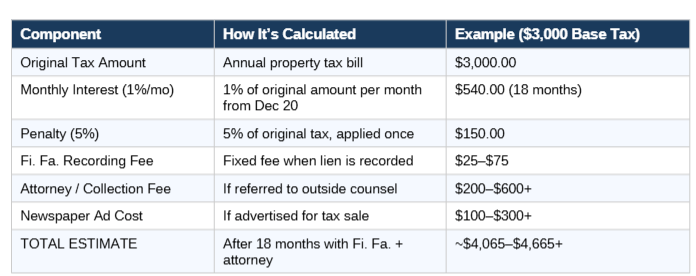
What this table illustrates is that a $3,000 annual tax bill left unpaid for 18 months does not result in a $3,000 payoff. It results in a payoff that can approach $4,500 or more — and that figure increases every month. This is why acting at Stage 1 is dramatically less expensive than waiting until Stage 3.
For the most current Georgia rules on how interest and penalties are applied, the Georgia Department of Revenue’s property tax overview provides authoritative guidance on state-level tax calculations and delinquency rules.
After a Tax Sale: Redemption Math
If your property has already gone to tax auction, the redemption calculation changes entirely. You are no longer paying the original delinquent amount. You must pay the winning bid — whatever the investor paid at auction — plus a 20% premium in the first year. In year two, the premium increases further. For a property auctioned for $40,000 in unpaid taxes, redemption in year one costs $48,000 — not $40,000. Many homeowners lose their redemption window simply because they didn’t understand this math in time.
Who Buys Properties from the Fulton County Delinquent Tax List?
The Fulton County delinquent tax list is not just a government record — it is a lead list actively used by real estate investors, cash buyers, and wholesalers across Metro Atlanta. Every homeowner on that list should understand this, because it changes how you interpret the letters and calls you may already be receiving.
Two Types of Buyers, Two Very Different Outcomes
Tax Sale Buyers — These are investors who bid at the public Fulton County tax auction. They typically pay the minimum amount required to cover the outstanding taxes and receive a tax deed subject to the 12-month redemption period. In this scenario, the homeowner receives nothing. The investor acquires the property for a fraction of its market value, and any equity the homeowner had accumulated over years of ownership is gone.
Pre-Sale Cash Buyers — These are investors or home-buying companies that contact homeowners before the tax sale with an offer to purchase the property as-is at a negotiated price. In this scenario, the sale generates real proceeds. The delinquent taxes are paid at closing from those proceeds. Any mortgage balance is paid off. And the homeowner walks away with whatever equity remains — instead of nothing.
The difference in outcome between these two scenarios is enormous. In the first, the homeowner loses everything. In the second, the homeowner resolves the delinquency, clears the title, and potentially walks away with cash. The only variable that separates these outcomes is whether the homeowner acts before or after the auction.
About Those Investor Letters
When a property appears on the Fulton County delinquent tax list, the homeowner often starts receiving letters, postcards, and phone calls from investors within weeks. These outreach efforts are not always predatory — many investors are legitimately offering to help homeowners exit a difficult situation while paying off the delinquency. But homeowners should understand exactly what they’re being offered before signing anything, and should independently verify their equity position before accepting any offer. An offer that seems generous may still be well below what the property is worth in Fulton County’s current market.
A homeowner who understands their equity position and acts before the tax sale has significantly more negotiating leverage than one who waits. Knowledge is the most valuable thing you have in this process.
Your 3 Options If Your Property Is on the Fulton County Delinquent Tax List
If you’ve found your property on the list, here are your three realistic paths forward — presented clearly so you can match your situation to the right option.
Option 1 — Pay the Balance in Full or Set Up a Payment Plan
This is always the preferred option if it’s financially feasible. Paying the full delinquent balance stops the clock immediately, removes the Fi. Fa. from your title, and restores a clean property record. Call the Fulton County Tax Commissioner’s office at (404) 612-6440 to get your exact current payoff figure — the number changes monthly, so get it directly rather than estimating from an old bill.
Fulton County does offer installment payment arrangements for delinquent taxes in certain circumstances. Eligibility is not guaranteed and these are typically structured over a short window — not a multi-year plan. Ask specifically about installment options when you call. Do not assume they are available without asking.
Option 2 — Apply for Exemptions or a Hardship Deferral
Many homeowners on the Fulton County delinquent tax list qualify for exemptions they have never applied for. Senior exemptions for homeowners age 62 and older can reduce annual tax liability by $800 to $1,500 or more. Disability exemptions, surviving spouse provisions, and the Georgia homestead exemption can further reduce what you owe going forward. A hardship deferral program exists for homeowners who have experienced a significant income disruption — ask the Tax Commissioner’s office whether your situation qualifies.
Important: exemptions reduce future liability. They do not, in most cases, retroactively erase existing delinquency. Think of them as part of a combined strategy — apply for every exemption you qualify for while simultaneously working on the existing delinquent balance through Option 1 or Option 3.
Option 3 — Sell the Property Before It Reaches Tax Sale
When paying is not financially feasible and exemptions do not fully close the gap, a voluntary sale before the auction is almost always a better outcome than losing the property at auction for the tax amount only. A pre-sale generates real proceeds that pay off the delinquent taxes, any mortgage balance, and remaining liens — and may put cash in the homeowner’s pocket. A tax auction, by contrast, generates nothing for the homeowner.
In Georgia, homeowners have the legal right to sell their property as-is to a cash buyer without making repairs, staging the home, or paying traditional commissions. Cash sales can close in 7 to 21 days — fast enough to beat most Fulton County tax sale deadlines. The delinquent taxes are paid at closing from the proceeds. To understand your full legal rights throughout this process, the Georgia Legal Aid property tax exemptions and homeowner rights guide is a reliable free resource.
Free Local Resources for Fulton County Homeowners Facing Tax Delinquency
You do not have to navigate this alone. Here are the most important free resources available to Fulton County homeowners dealing with property tax delinquency.
Fulton County Tax Commissioner’s Office — Your first call for any question about your balance, Fi. Fa. status, payment options, or tax sale timeline. Reach them at (404) 612-6440 or through the official Fulton County Tax Commissioner property tax portal.
Fulton County Board of Assessors — If you believe your home’s assessed value is too high — which directly inflates your annual tax bill — you have the right to appeal within 45 days of receiving your assessment notice. A successful appeal reduces your ongoing tax liability permanently. Visit fultonassessor.org for appeal information.
Georgia Legal Aid — Free plain-language resources on tax sale rights, Fi. Fa. explanations, and redemption timelines for qualifying homeowners. Visit georgialegalaid.org for online guides or to check eligibility for direct legal representation.
Atlanta Legal Aid Society — Provides free legal representation for low-income homeowners in Fulton County facing tax sale or foreclosure. Reach them at (404) 524-5811.
HUD-Approved Housing Counselors — Free or low-cost professional counseling for homeowners navigating tax delinquency, mortgage default, or foreclosure. The HUD-approved housing counselor locator near Atlanta connects you with certified counselors who can review your full financial picture confidentially and at no cost.
Georgia Senior Legal Hotline — Free legal advice for homeowners age 60 and older on property tax issues, exemption eligibility, and housing-related matters. Call (404) 389-9992.
Acting early — even making one phone call today — dramatically expands the options available to you. Every week of delay is a week of compounding interest, shrinking equity, and narrowing choices.
Final Thoughts: The List Is Public — So Is the Path Forward
The Fulton County delinquent tax list is public record, and that visibility cuts both ways. Investors are watching it. But so are housing counselors, legal aid attorneys, and local resources specifically designed to help homeowners who find themselves on it.
Whether you discovered your property is on the list today, or you’ve known for months and haven’t known where to turn, the most important thing you can do right now is understand exactly where you are in the delinquency timeline and what each option will actually cost you. From Stage 1 to Stage 4, the options are different — but options exist at every stage.
The homeowners who come out ahead are the ones who gather real information, understand their equity position, and act before a court date or auction advertisement makes the decision for them.
Have Questions About Your Fulton County Property Taxes? Let’s Talk.
If you found your property on the Fulton County delinquent tax list — or you’re worried it might be there — reach out to Atlanta Housing 411 today. I’m Gerald Harris, and I’ve helped homeowners across Fulton County and Metro Atlanta understand exactly where they stand before a tax sale changes everything. Whether you need to understand your payoff amount, explore your exemption options, or figure out whether selling makes more sense than paying, I can help you think it through without pressure and without judgment.
Don’t wait until your property is advertised in the newspaper. The earlier you reach out, the more options you have.
📞 Call or Text: 404-913-7086 📧 Email: atlanta285.com@gmail.com
Visit Atlanta Housing 411 — Contact Gerald Harris — No pressure. No judgment. Just honest local guidance.